
Loading...


Bring up the phrase “communications audit” to a room full of people and some might picture a PowerPoint pack full of charts, spreadsheets and engagement figures. They’re not wrong exactly. The thing is, those metrics rarely explain why an organisation's communications are or aren’t working.
Bring up the phrase “communications audit” to a room full of people and some might picture a PowerPoint pack full of charts, spreadsheets and engagement figures. They’re not wrong exactly. The thing is, those metrics rarely explain why an organisation's communications are or aren’t working.
Numbers can tell you that website traffic is up, or that LinkedIn engagement has dipped. What they can’t show you is whethery our communications are reaching the right people, supporting your wider goals or making the most of your team’s time. You need to look a little deeper for these types of insights. This is how our work with Elrha began.
Elrha is a global organisation funding humanitarian research and innovation. Over the years, it’s built a reputation across the sector as a problem solver for complex issues like gender-based violence, undernutrition, food insecurity and non-communicable diseases. Elrha’s website holds significant volumes of evidence and resources, and its newsletter reaches an engaged audience of researchers and practitioners. The organisation’s LinkedIn following sits at more than 15,000 highly relevant contacts.
At first glance, trust wasn’t an issue. Elrha had already established its authority, but the issue was getting the message in front of more people. The message also needed to work for a smaller communications team to deliver. When Restless Stories got involved (in collaboration with the amazing Yalla Cooperative), the below was the approach we recommended.
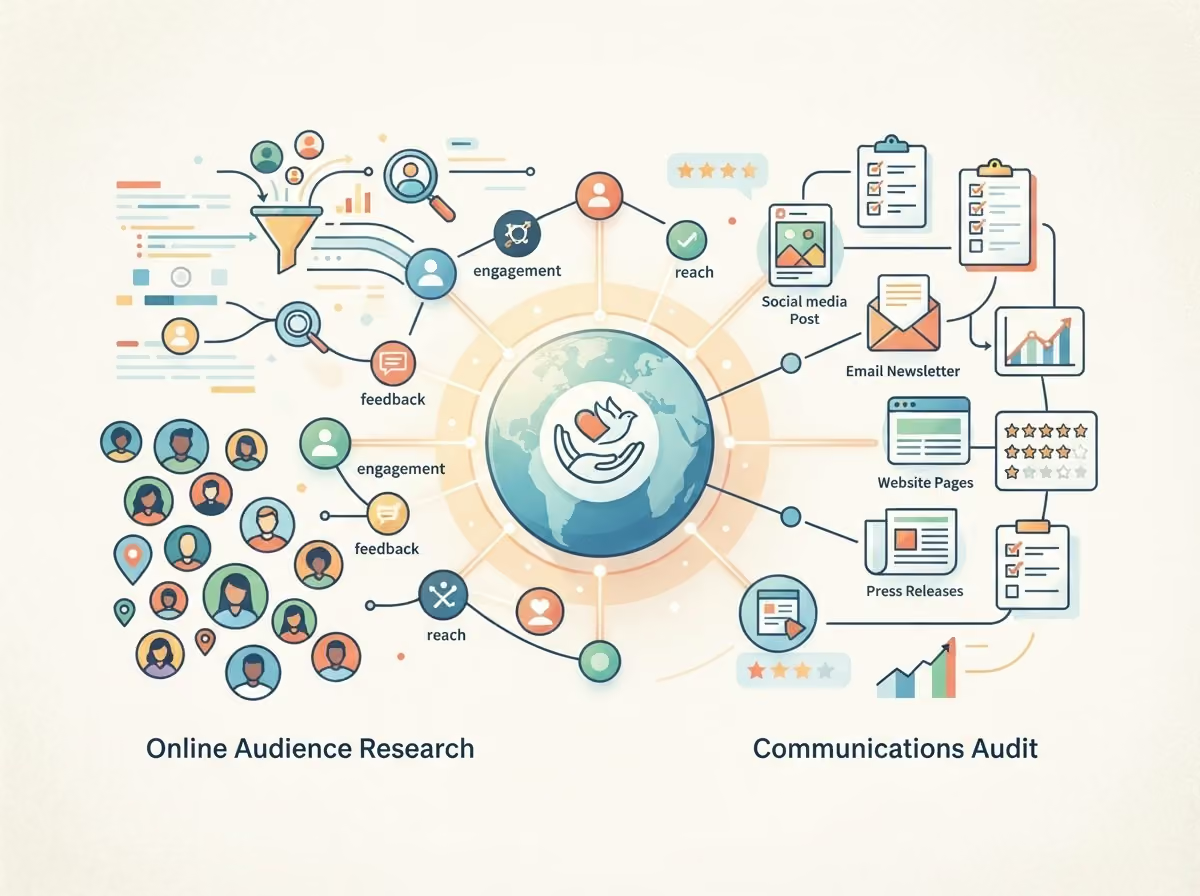
We didn’t start making a bunch of generic recommendations. Instead, we looked to understand Elrha’s ecosystem as a whole.We’re talking website performance, search visibility, newsletter engagement, social activity and how different audiences discover information and use the individual channels.
We also spent time learning the ins and outs of the organisation. With two communications managers leaving and a leaner team coming together, our recommendations had to be realistic. Handing over an ambitious strategy that depends on resources that no longer exist wouldn’t do anyone any favours. Our goal was to strengthen Elrha’s communications while making it easier for the organisation to execute.
Fortunately, the foundations were strong. The website worked as a trusted source of evidence. LinkedIn was where the organisation’s professional audience already lived. Elrha’s newsletter kept an established audience engaged. There was no point rebuilding or redesigning any of this. What we could do was help each channel do its job a little better.
The first place to start was understanding how the organisation compares with others in the same space. We analysed communications across the humanitarian research and innovation sector.Specifically, we looked at how these organisations structure content, engage audiences and balance thought leadership against announcements. Our LinkedIn audit covered demographics, profile optimisation, publishing cadence, content formats and platform best practices.
Elrha had a relevant audience. Its communications were largely publication-led, though. Reports, funding announcements and organisational updates were getting the job done. We discovered scope for more insight-led content, stronger thought leadership and a publishing approach that better matched how professionals consume LinkedIn today.
As part of our audience research, we used multiple data sources - aggregating anonymised clickstream panels and public professional/social profile information to analyse where audiences spend time online:

Once we had an understanding of the landscape, we started identifying areas of improvement. Instead of diving in head-first, we built a list capturing realistic options. For example:
● Strengthening SEO
● Restructuring long-form publishing
● Introducing leadership amplification
● Expanding onto new platforms
● Developing more systematic content r epurposing
● Exploring video-first workflows
Taking this broader view meant the organisation could see the full landscape and decide where to focus its energy. In our experience, there’s no such thing as a silver-bullet solution. We find that better outcomes come from understanding trade-offs between multiple good ideas.
This stage was about narrowing down the list into practical priorities. Working closely with the team at Elrha, we assessed each opportunity against its likely impact, the resources it would take to deliver and how well it supported the organisation’s longer-term goals.
We ended up with a clear shortlist of initiatives focused on optimisation rather than expansion. The strategy included:
● Treat Elrha’s website as its most valuable long-term communications asset
● Strengthen search through structured, article-based publishing
● Embed leadership and expert voices into LinkedIn
● Improve content repurposing
● Introduce repeatable workflows that would ease pressure on the team while increasing visibility of its work
We agreed that the goal wasn’t to produce more content. The focus became getting what it already had in front of more people.
Any good communications audit leaves organisations with a clear sense of where to start, which is exactly what we did for Elrha. Our final step was transforming the strategy into a practical roadmap, complete with editorial planning, content pillars, publishing workflows, platform priorities and a little room for experimentation.
As part of the plan, we highlighted quick wins the team could act on straight away. We also recommended longer-term structural changes like SEO, leadership amplification and programme-specific content hubs designed to build visibility steadily over time.
The most important piece was ensuring that communications became more systematic. We didn't want every report, funding call or research publication to be treated as a one-off. Instead, we encouraged a model where a single significant output could generate multiple articles,v ideos, social posts and conversations. This would have a greater impact without a proportional increase in workload.
After spending time with Elrha, we walked away with multiple lessons that are valuable to every organisation. The first wast hat credibility and visibility aren’t the same thing. Elrha had an established audience, built over years of rigorous research. The challenge, though, was making sure that this expertise was easy to find, share and engage with.
Next, a good strategy doesn’t necessarily mean doing more. Our approach is to help clients decide where to put their time and attention. When communications teams are stretched thin, prioritisation is justas important as creativity.
Lastly, an audit isn’t just about generating a report. It’s about understanding the organisation’s strengths and establishing a framework based on what matters most. This allows communications to stop being a series of one-off campaigns. Instead, they become a system that evolves and strengthens over time.
Restless Stories is a digital creative studio
registered in England and Wales
as a limited company 16989146

.webp)
.webp)


